
The promise of empowering business users to build tailor-made solutions with little to no code is not a revolution. It is a decades-old recurring dream.
Microsoft's support for business-led software began in 1992 with Microsoft Access, allowing departments to spin up desktop databases. In the 2000s, Excel with VBA became the unofficial backbone of global finance. Then came SharePoint (2001) lists and workflows, InfoPath (2003), and SharePoint Designer (2007), all promising to bridge the gap between "the business" and "the dev."
Today, we have the Microsoft Power Platform. With Power Apps and Power Automate, we are witnessing the transition to a unified, cloud-native citizen development era.
But as a former software engineer, I have some questions.
In my "former life," I saw how quickly professional systems can fail. I have seen secure stock trading platforms cracked in 48 hours by pentest teams. I have seen server farms brought to their knees by a single cache misconfiguration. I have seen undocumented solutions that cause havoc during migrations, left behind by people who exited the company years ago.
When we move from professional dev environments to the "anyone can build it" model, we risk ignoring the four horsemen of software stability:
- Security: Will an HR dashboard accidentally leak the entire payroll to the "All Staff" group?
- Performance: Will a poorly optimized finance supporting app freeze business operations when the workload increases?
- Documentation: Who explains how the app works when the "Citizen Developer" gets promoted or leaves?
- Maintainability: How do we patch a system that was not built with a lifecycle in mind?
Buzz vs reality
The marketing for Low-Code/No-Code solutions, supercharged by the AI revolution, has set expectations sky-high. Vibe coding suggests that the "backlog" is a thing of the past because the business can just build it themselves.
I am intrigued, but cautious. If we position these tools as "Anyone can build anything," we are not innovating. We are simply recreating the Excel/Access chaos of the 90s, just hosted in the cloud.
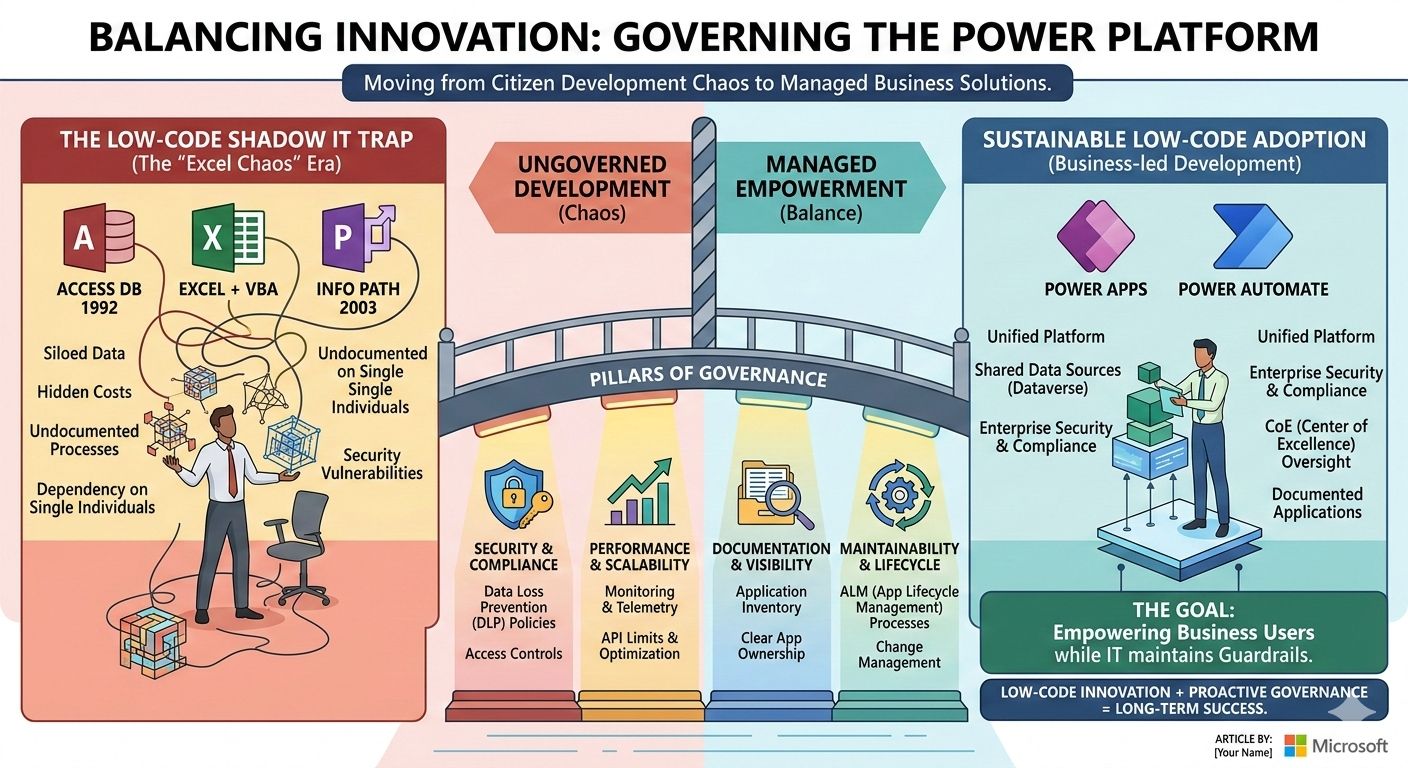
Power Apps should not be sold as the democratization of coding. Instead, they must be positioned as: "Business-led development within IT guardrails."
Without governance, "Low code" eventually becomes "High debt." The goal should not be to turn every HR officer into a programmer. It should be to give them the tools to solve problems without breaking the digital foundation of the company.
#PowerPlatform #Microsoft #LowCode #CitizenDevelopment #DigitalTransformation #PowerApps