
I frequently fly back and forth between Greece and Luxembourg and I find myself using different mobile applications and services to accomplish basic daily tasks.
Instant payments is one example. In Greece, IRIS was even made legally mandatory for self-employed professionals and businesses, while Payconiq is the way to go in Luxembourg and something else entirely in neighboring European countries.
I am very happy this is about to change, as two initiatives are coming to fruition very soon.
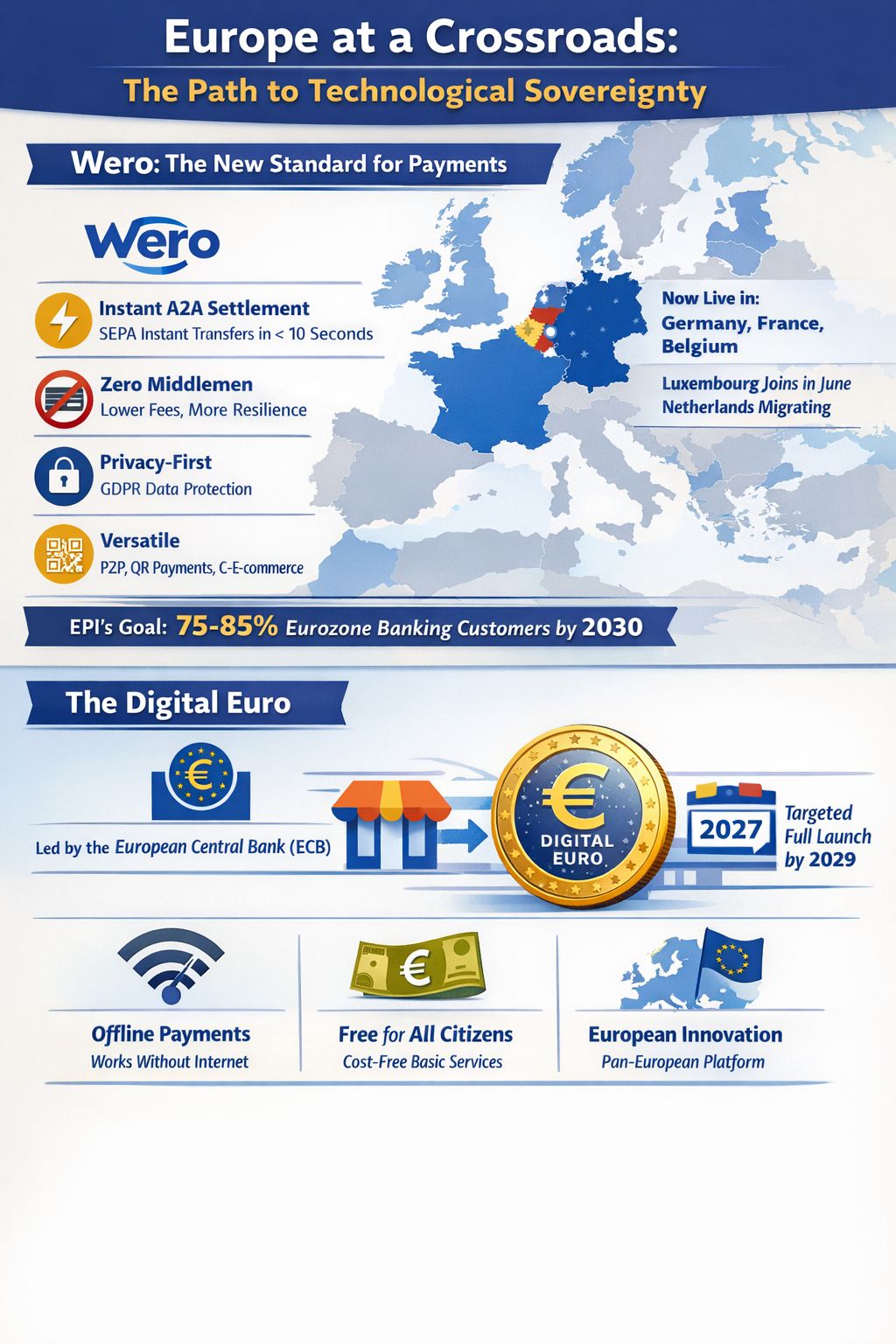
- Money moves in under 10 seconds
- Bypasses traditional card networks and reduces transaction fees
- Data stays within European jurisdiction
- Offers peer-to-peer transactions, QR payments, and e-commerce checkouts
It is already operational in Germany, France, and Belgium. Luxembourg will be replacing Payconiq in June and the Netherlands is already migrating the iDEAL user base. The goal is to cover 75–85% of banking customers across the Eurozone by the end of the decade.
The Digital Euro
While Wero is a private initiative by banks, the Digital Euro is the public-sector pillar of European Digital Sovereignty. Led by the European Central Bank (ECB), the preparation phase was concluded in late 2025. It is now moving into pilot testing in 2027 and a potential full rollout is estimated by 2029.
- Payments without an internet connection
- Basic services will be free
- Provides a pan-European platform for private companies to innovate on
The Road Ahead
Between the two initiatives, Europe is building both a private-sector payment rail and a sovereign digital currency. The timeline from here to full adoption spans just a few years:
The bottom line: Europe is no longer just regulating payments — it is building the infrastructure itself. Two complementary pillars: a private instant payment network (Wero) and a public digital currency (Digital Euro). For anyone living across borders inside the EU, this long-overdue convergence cannot come soon enough.
Are you already using Wero? Or are you still juggling different apps depending on which country you're in? Drop a comment — I'd love to know how others are navigating Europe's payment patchwork.