
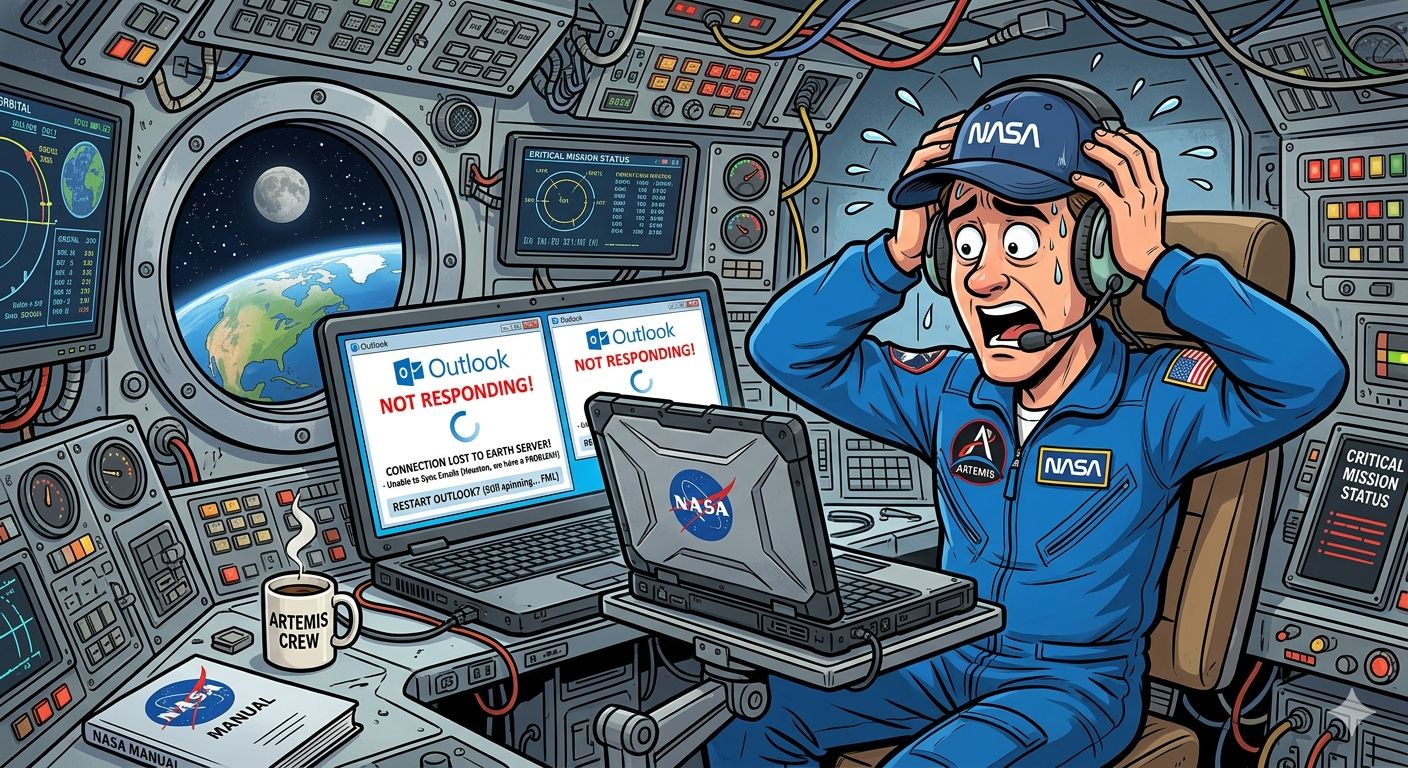
Last week, during the Artemis II mission (humanity's most ambitious crewed spaceflight in over 50 years) Commander Reid Wiseman radioed Mission Control from 30,000 miles above Earth with a problem that every office worker will recognise:
"I have two Microsoft Outlooks, and neither one of those is working."
NASA engineers spent an hour remoting into a Surface Pro. In space. To fix Outlook.
Think about that for a second. We sent four astronauts farther from Earth than any humans in history... and their first IT ticket was about something very familiar to all of us.
A victim of its own strategy
Back on Earth, Outlook is becoming a victim of Microsoft's technological obsolescence strategy.
We have been conditioned to believe that "new" always means "better." I have always been an early adopter and switched to Outlook New on my personal laptop long before my corporate environment caught up. I wanted to be ahead of the curve.
Yet many months later, I am still trying to force a connection that just isn't there. I find myself constantly glancing back at the Classic version like an old friend I wasn't ready to say goodbye to.
A wrapper, not an upgrade
The shift feels fundamentally different this time. Microsoft is pushing a web-based wrapper to replace a native application. We are trading deep functionality for a unified codebase that serves the company more than the user.
I still show up for Outlook New every day, but my heart is still with the Classic and I often go back to it.
If Outlook can't hold it together 30,000 miles above Earth on humanity's greatest adventure, maybe it is time we asked: is it really progress if we have to convince ourselves to like it?
#Microsoft365 #Outlook #ProductivityTools #UserExperience #Artemis #TechHumor